
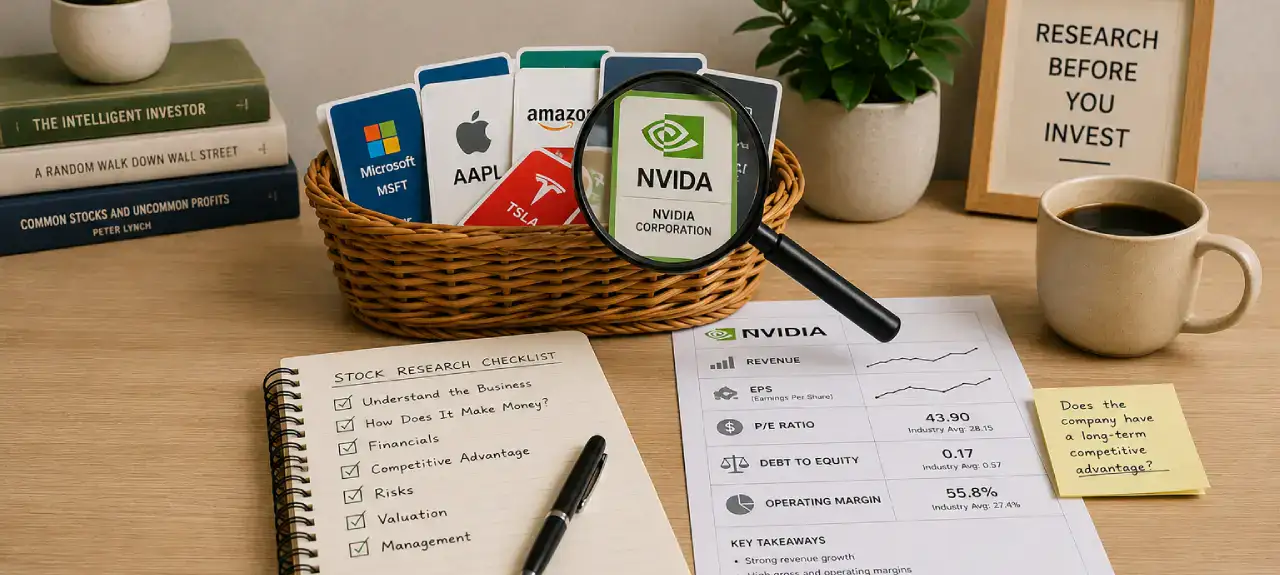
In my last post, ETFs and Index Funds vs Individual Stocks, we talked about when it makes sense to start adding individual stocks to your portfolio. If you have decided you are ready to take that step, the natural next question is — how do you actually research a stock before you buy it?
This post is going to keep things elementary on purpose. Stock research can get incredibly deep, and there are people who spend their entire careers studying the financials of a single industry. You do not need a finance degree to make smart decisions about a few companies. You just need to know what matters and what to ignore.
This is not about finding the next big thing. It is about understanding what you are buying before you buy it. There will be a time when you can take a small portion of your portfolio and put it on a flyer — a speculative bet on the next big thing — but now is not that time.
Start With Something You Understand
Before you look at a single number, ask yourself one question — do I actually understand what this company does and how it makes money?
If you cannot explain a company in a sentence or two to a friend, you may want to focus elsewhere. Again, we are just getting started with researching stocks and investing so stick with things you are more comfortable with.
A great place to start is with companies you already know from everyday life. Do you go to Starbucks every morning? Is your local Chipotle always packed at lunch? Do you keep buying Apple products? These are companies you already have firsthand experience with. You know whether the product is good, whether people keep coming back, and whether the stores are busy.
That kind of real-world observation and experience is genuinely valuable. Peter Lynch — one of the greatest investors of all time — built much of his career on this idea. He believed regular people often spot trends in companies they use long before Wall Street does.
You do not have to invest in those exact companies. But starting your research with businesses you already understand makes the whole process feel less intimidating.
How Does the Company Make Money?
Once you know what the company does, the next step is understanding how it actually makes money.
Are sales growing year over year? Does the business depend on one product or many? Does it have one big customer or thousands? Is it seasonal?
You can usually find this information on the company’s investor relations page, or by reading a recent earnings summary at CNBC (my go-to) or on Yahoo Finance or your brokerage platform.
The goal here is not to memorize numbers. It is to make sure you can describe the business to a friend in plain language.
The Numbers That Actually Matter
There are many metrics analysts use to evaluate companies. Here are some basic financial numbers you can focus on as you get started:
Revenue Growth
Is the company selling more this year than last year? Look for steady growth over multiple years, not just one good quarter. Consistent growth tells you the business is healthy and expanding. Without getting too in the weeds, year-over-year growth can depend on where the company is in its cycle. Here is a quick example.
In the first year after COVID, the stock of some companies increased significantly because of their focus on allowing people to live their lives while stuck at home. Zoom Video Communications (Ticker: ZM) was one of those companies. Companies flocked to this platform and revenue skyrocketed.
Once COVID was under control and the workforce returned to the office, it was difficult to maintain that level of growth. If you looked a year later, you would not see revenue growth. That doesn’t make Zoom a bad company. It just shows that revenue growth alone does not tell the full story — context matters.

Profit Margins
How much of every dollar in sales does the company actually keep as profit? A company can have huge revenue but still make almost no money. Higher margins generally mean a stronger, more efficient business.
Earnings Per Share (EPS)
This is the company’s profit divided by the number of shares. You want to see this growing over time. It tells you each share you own is becoming more valuable.
The P/E Ratio (Price to Earnings)
This is how much you are paying for every dollar the company earns. A high P/E means investors expect a lot of growth. A low P/E might mean a bargain — or it might mean the company is struggling.
The most useful way to look at P/E is to compare it to other companies in the same industry. A tech company will almost always have a higher P/E than a utility company. That is normal.
Let’s look at Nvidia (Ticker: NVDA) as an example. Nvidia is a company with exponential stock growth in recent years tied to their participation in the growth of artificial intelligence.
On May 8, Nvidia stock closed at $215.90 with earnings per share of $4.90. To find the P/E ratio, you simply divide the price by the earnings: $215.90 ÷ $4.90 = 43.90. That means investors are paying about $43.90 for every $1 of Nvidia’s earnings. That is considered a high P/E, but Nvidia is a fast-growing company so investors are paying up for future growth.
By comparison, let’s look at Procter & Gamble (Ticker: PG) on the same day. Its P/E ratio was 21.41. Procter & Gamble is a mature, stable business selling many brands you likely use daily (Tide, Charmin toilet paper, Dawn dish soap). It is not growing as fast as Nvidia but its earnings are more reliable and predictable. So investors pay less for each dollar of earnings.
Neither P/E is “right” or “wrong.” A high P/E is not automatically a bad thing and a low P/E is not automatically good. What matters is whether the P/E makes sense for the type of company you are looking at.
Debt
How much does the company owe? Some debt is fine and even healthy. A lot of debt — especially compared to similar companies — is a warning sign. Debt becomes especially dangerous when interest rates rise or sales slow down. Debt to Equity is a key metric tied to debt but we will stay high-level for now.
Dividends
If the company pays a dividend, look at two things. Is it consistent? Has it been growing? A stable, growing dividend is usually a sign of a healthy, mature business.
But here is something a lot of beginner investors miss. An unusually high dividend can actually be a warning sign. If a stock is paying a 9 or 10 percent dividend when similar companies pay 2 or 3 percent, that high yield often signals trouble. Either the stock price has dropped sharply (which mathematically pushes the yield up), or the dividend itself may not be sustainable. A dividend cut is often followed by a falling stock price.
Look for consistency and reasonable yields. Not the highest number you can find.
Where to Research a Stock
You do not need expensive software or a Wall Street subscription. Almost everything you need is free.
- The company’s investor relations page. Every public company has one. This is where they post earnings reports, annual reports, and investor presentations. A lot of this information is accumulated at sites like those listed below. Here is the Nvidia Investor Relations page.
- CNBC: This is certainly my go-to. I listen to CNBC driving to work. Any information you want can be found here. If there is enough interest, I am happy to post a video navigating the CNBC site.
- Yahoo Finance or Google Finance. Quick summaries of all the basic numbers, plus news and history.
- Your brokerage platform. Fidelity, Schwab, and most major brokerages have research tools built right in.
- The annual report. Intimidating at first, but the first few pages usually summarize everything you need to know. The annual report, as mentioned above, can be found at a company’s investor relations page. The annual report is commonly referred to as the 10-K.
You do not have to read SEC filings cover to cover. The sites mentioned above do a great job of summarizing data.
Common Red Flags to Watch For
As you research, here are some warning signs that should make you pause:
- The company has not made a profit in years and there is no clear path to one
- Debt is growing faster than revenue
- The story keeps changing — every year there is a new “big thing” that will turn the company around
- One customer or one product accounts for almost all of the revenue
- The dividend yield looks too good to be true — unusually high dividends can mean the stock is in trouble or the dividend is at risk of being cut
- Insiders (company executives) are selling large amounts of their own stock
- You cannot explain the business to a friend
Any one of these alone might not be a deal breaker. But when you see several together, that is your signal to walk away.
What to Watch for After You Start Investing
Once you have done your research and identified companies you might want to own, the next step is paying attention.
Successful investing is not just about what you buy. It is also about staying informed once you own a company and recognizing when opportunities show up.
Stay Current With News and Earnings
Make a habit of checking in on your companies regularly. You do not need to watch the stock price every day — that will only stress you out. But you should:
- Read major news about the company when it comes up
- Pay attention to quarterly earnings reports (every public company releases these four times a year). Quarterly reports are called 10-Qs.
- Note any big changes in leadership, product direction, or industry conditions
Once you know an earnings report is coming, the next skill is actually reading it. I walk through that step by step in how to read an earnings release.
Most brokerage platforms will email you when a company you own reports earnings. Yahoo Finance and Google Finance will too. This is free, automatic, and worth setting up.
Bad News Can Sometimes Be a Buying Opportunity
Here is something experienced investors understand that most beginners do not.
Sometimes a great company’s stock falls dramatically because of bad news that turns out to be temporary. The stock gets hammered, sales drop, and the headlines look terrible. But the underlying business is still strong, and eventually the company recovers.
A good example was Chipotle in 2015 and 2016. An E. coli outbreak in some of their restaurants caused the stock to drop sharply. The news was bad. Sales fell. Headlines were brutal. But Chipotle was still a strong business with loyal customers and good locations. Investors who recognized that and bought during the worst of it saw their investment grow significantly in the years that followed.
This is not easy to do. It requires the discipline to buy when everyone else is selling, and the judgment to tell the difference between a temporary problem and a real one.
A few questions to ask yourself when a stock you have been watching gets hit by bad news:
- Is this a short-term problem or a fundamental one?
- Will customers come back once the issue is resolved?
- Is the company financially strong enough to survive while it recovers?
- Has anything actually changed about why I liked this company in the first place?
If the answers are reassuring, that drop might be an opportunity rather than a warning. If they are not, walk away.
This kind of timing is more advanced and not something a brand new investor should rush into. But it is worth understanding now so you can recognize it when you see it.
Keep It Simple
Here is the most important thing to remember.
You will not pick winners every time. Even professional investors do not. The goal is to make informed decisions about the companies you own — not to predict the future.
Pick businesses you understand. Look at the basic numbers. Watch for the red flags. That alone puts you ahead of most casual investors.
Stock research is a skill that grows with practice. Your first few will feel slow and uncertain. By your tenth, you will start seeing patterns. By your fiftieth, you will have real instincts for what to look for.
Conclusion
You do not need to be a financial expert to research a stock. You need curiosity, patience, and a willingness to look at the basics before you buy.
Start with a company you already understand. Look at how it makes money. Check the basic numbers. Watch for red flags. Then make your decision.
And remember, as always:
Start investing. Stay consistent. Give your money time to grow.
If you want to see this framework applied to a real company from start to finish, my next post walks through researching Johnson & Johnson — the metrics, the lawsuits, the crisis-response lens, and a free downloadable worksheet you can use on any stock.



Weekly Notes — October 10, 2026