
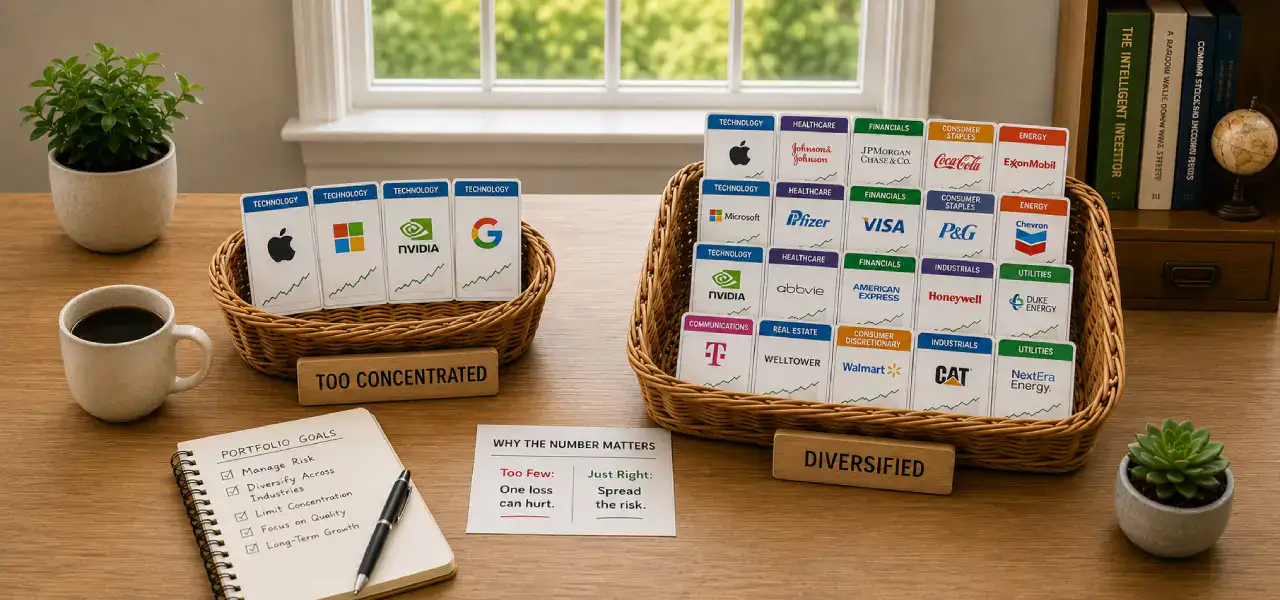
In How to Research a Stock Before You Buy It, we covered the basics of figuring out whether a company is worth owning. Once you start putting that knowledge to work, the next question is — how many stocks should you actually own?
Let me be upfront. There is no perfect number. But there is a range that experts generally agree on, and there are good reasons why owning too few or too many can both hurt your returns.
This post walks through what the experts say and how to think about the right number for your portfolio.
Why the Number Matters
The number of stocks you own creates two very different kinds of risk.
Too Few Stocks
If you only own three or four companies and one of them has a bad quarter, loses a big contract, or encounters a big legal issue, your whole portfolio takes a hit. This is called concentration risk — when too much of your money is tied to only a few outcomes.
New investors often underestimate how often individual companies run into trouble. Even great companies can have a bad stretch.
Certainly there are times when holding only a few stocks would greatly benefit you. I have a diversified portfolio that includes Nvidia. If I had only owned Nvidia since the start of 2024, my portfolio would have increased 339% in just under 2.5 years. A $10,000 investment would have grown to over $44,000 in less than two and a half years.
That is the seductive part of concentration. When you pick the right stock at the right time, the returns can be incredible.
Let’s say you were optimistic about Moderna instead. This is a household name from the COVID era and it was one of the biggest winners of that time, closing as high as $484 in August 2021. A year later it was around $115. It began 2024 around $100 per share and today it sits around $56 — a 44% decline. A $10,000 investment would be worth $5,600 today.
Two well-known companies. Same time period. Wildly different outcomes.
Not Every Stock Will Be a Winner
Here is the truth that experienced investors learn over time. Every stock you pick will not be a winner. Even the best investors lose money on individual stocks regularly. What matters is that the wins more than make up for the losses, and that no single loss can do serious damage to your overall portfolio.
That is exactly why you diversify.
If you had owned both Nvidia and Moderna in 2024, along with 18 other stocks across different industries, the Nvidia gain would have lifted your overall portfolio while the Moderna decline would have been a small drag — not a disaster.
Diversification does not protect you from losses. It protects you from any single loss being catastrophic.
Too Many Stocks
On the other end, if you are trying to own 60, 80, or 100 stocks, you have a different problem. You cannot realistically keep up with all of them. You also start to mirror the overall market — at which point, you should just buy an ETF or index fund.
This is an important point. If you find yourself wanting to own that many companies just for the sake of diversification, you are essentially recreating an index fund — but more expensively and with more work. Individual stocks should supplement your ETFs and index funds, not replace them.
The right number sits somewhere between those two extremes.
What the Experts Say
Decades of academic research and the broad consensus among financial advisors land in a similar place. Most agree that somewhere between 20 and 30 stocks gives you the bulk of the diversification benefit you can get from owning individual companies.
Studies have shown that going from 10 stocks to 20 cuts your risk meaningfully, and reaching 30 or so captures most of the remaining benefit. Beyond that point, additional stocks add very little. You are not really reducing risk anymore — you are just adding work.
Below 10 to 15 stocks, the risk picture changes. You start carrying meaningful concentration risk. One bad pick can have a real impact on your overall returns.
This is the framework most investors should follow.
Currently I find myself violating this rule in an account I help manage for a family member. I would have bet you money I had 20 stocks but currently have 40! I have done very well but I do need to scale this back. Initially, I had a theory to keep most holdings at around $5,000. When reviewing the account, if a balance had grown to, for example, $8,000 — I would sell some shares to bring the balance back down. Over time, this adds up, I purchase new stocks and, poof, I have 40 stocks utilizing the same concept. This is proof that you should always review your accounts.
A Word About Warren Buffett
You will eventually come across Warren Buffett’s name in any conversation about investing, so it is worth addressing his approach directly.
Before I do, let me say I am a huge admirer of Warren Buffett. He built one of the most remarkable companies in history and has given billions to charity. Even after decades of success, Buffett still lives in the same modest house he bought years ago and leads a humble life despite having every reason not to. He is an icon in this space and rightly so.
Buffett has long argued for running concentrated portfolios — owning just a handful of companies you really understand. On the surface, that sounds like it conflicts with the advice in this post.
Here is the important context.
Buffett and his team do not research companies the way most people do. Their work is full time. Meetings with management teams, facility tours, conversations with suppliers and customers, and reading every filing going back decades — this is the day job, not a weekend hobby. Many of these investments are held for 20, 30, or 40 years. That is a fundamentally different activity than what a regular investor does.
There is also a scale issue worth mentioning. When Buffett refers to a “small” or “normal” amount of capital, he has generally meant something in the range of a million dollars or more. That is not the audience for this post. Most regular investors are working with thousands of dollars, not millions.
And honestly, even at a million dollars, owning only six stocks is risky for someone without Buffett’s resources. Each stock would represent about 17 percent of the portfolio. If one runs into trouble — which happens to even great companies — the impact is significant. Buffett can absorb that. Most investors cannot.
The takeaway is not that Buffett is wrong. He is brilliant. The takeaway is that his approach was built for someone operating at his level, with his resources, and with his decades of experience. For the rest of us, the broader consensus of owning 20 to 30 stocks is a safer path.
A Practical Range for Most Investors
So where does that leave you?
For most investors building a portfolio of individual stocks, somewhere between 15 and 25 stocks is a reasonable target. This range gives you:
- Enough diversification that one bad pick will not sink you
- Few enough companies that you can actually keep up with them
- Room to spread your investments across different industries
- A supplement to the ETF and index fund foundation you already hold (more on this below)
This is not a magic number. Some investors will be comfortable with 15. Others will want closer to 25 or 30. What matters is that you can keep up with the companies you own.
You Do Not Need a Lot of Money to Own Many Stocks
A quick word for anyone reading this and thinking — “I do not have enough money to own 15 or 20 different stocks.”
Twenty or thirty years ago, that concern would have been valid. Back then, you typically needed a decent sized portfolio to own that many companies. There were two main reasons.
First, trading fees were real. Most brokerages charged $10, $15, or even more for every trade. If you were only buying a few shares of a company, those fees would eat up a meaningful percentage of your investment.
Second, and more importantly, you had to buy whole shares. If a stock was trading at $300 a share and you only had $200 to invest in it, you were out of luck. Owning 20 stocks meant having enough money to buy at least one full share of each — and for higher-priced stocks, that added up fast.
Today, the rules have completely changed.
Most major brokerages now offer commission-free trading. Fidelity, Schwab, Robinhood, and others have eliminated the per-trade fees that used to make small purchases impractical.
Even bigger — fractional shares are now widely available. Want to put $50 into a stock that trades at $900 a share? You can. You will own a small fraction of a share, and it will grow with the company just like a full share would. J.P. Morgan Wealth Management, SOFI, Robinhood and Fidelity are just a few of the brokerages that offer fractional shares. I personally have used SoFi to teach my daughter how to invest. I put $250 in the account every month and work with her to choose stocks. She can choose from any company regardless of the share price thanks to the ability to purchase fractional shares. Instead of needing the full price of a single share of Costco, she can buy $50 worth.
This means a beginner with a few thousand dollars — or even a few hundred — can build a diversified portfolio of individual stocks. The barrier that used to keep small investors out of the game is largely gone.
Spread Them Across Industries
Owning 20 stocks means very little if all 20 are tech companies.
Real diversification comes from owning companies across different industries — technology, healthcare, consumer goods, financial services, energy, industrials, and so on. When one sector has a bad year, the others can help cushion the blow.
A simple rule of thumb is not to keep more than 20 to 25 percent of your individual stock portfolio in any one sector. If half your stocks are technology companies, you do not really have a diversified portfolio. You have a tech bet.
How Much Should You Put in Any One Stock?
This is called position sizing, and it is just as important as how many stocks you own.
A common guideline is that no single stock should represent more than 5 percent of your individual stock portfolio when you first buy it. Some investors stretch this to 7 or 8 percent for their highest-conviction picks — those companies they believe in the most.
Here is why this matters. If you put 30 percent of your money into one stock and that company runs into trouble, you can lose years of gains overnight. Position sizing protects you from yourself.
One note on this — over time, your best performers will grow into a larger share of your portfolio. That is actually a good thing. It means you picked well. But if a single stock grows to 15 or 20 percent of your portfolio, it is worth pausing to think about whether you want to trim it back to manage your risk.
Do Not Forget Your ETFs and Index Funds
This is worth saying again, because it ties the whole investing series together.
The number of individual stocks you own is a separate question from your overall portfolio. For most investors, individual stocks should sit alongside a core of ETFs and index funds — not replace them.
A typical structure looks something like this:
- A core of broad-market ETFs and index funds for stability and overall market exposure
- A smaller allocation to individual stocks where you put in the research
So if you own 20 individual stocks, those might represent 20 to 30 percent of your overall investments, with the rest in ETFs and index funds. The exact mix depends on your knowledge level, your time, and your comfort with risk.
I personally hold approximately 20% of my portfolio in ETFs and 80% in individual stocks. But I want to be clear about why. I have been investing for many years, I research companies regularly, and I have built up the experience and confidence to manage a heavier individual stock allocation. This is exactly the kind of shift that can happen as you become more seasoned. For a beginner, that ratio should be the other way around — heavy ETFs, lighter individual stocks. As your knowledge and experience grow, the mix can evolve.
The bottom line is that individual stocks complement your foundation. They do not have to be the foundation.
How to Transition Into Individual Stocks
This is something a lot of new investors miss, and it is worth slowing down on.
If you have been investing in ETFs and index funds, you are already diversified across hundreds — sometimes thousands — of companies. That is the whole point of those funds.
So when you buy your first individual stock, you are not suddenly undiversified just because you only own one. You still have your ETFs and index funds doing their job. Your individual stock is an addition to a portfolio that is already spread across the broader market.
This matters because it takes the pressure off.
You do not have to rush out and buy 15 stocks at once. You can buy your first individual stock, learn from it, and add another when you find a company you have done your research on. Then another. Over months or years, you can build up to that 15 to 25 range at your own pace.
A practical way to think about it:
- Keep building your ETFs and index funds. That foundation does not change.
- Add individual stocks gradually as you find companies you understand and believe in.
- Let your individual stock portfolio grow naturally over time.
There is no race here. Some investors take five or ten years to build out a full individual stock portfolio. That is fine. Patient, deliberate stock buying tends to produce better results than rushing to fill a target number.
Another benefit of this approach — every individual stock you buy along the way is a learning experience. By the time you have 15 stocks, you will have learned a tremendous amount from each one. That experience is worth more than hitting any specific number quickly.
What Number Works for You
Here is some practical guidance depending on where you are in your investing journey:
Just Getting Started With Individual Stocks
Begin with a few stocks and grow to 5 to 10 from there. Trying to research 25 companies on day one is overwhelming and will probably lead to rushed decisions. Build slowly.
Building Over Time
As you gain knowledge and experience, work toward 15 to 25 stocks across different industries. This is the sweet spot for most investors who want to actively manage individual positions.
Experienced and Engaged
You may settle on a number that fits your style — anywhere from 15 to 30 depending on how concentrated or spread out you want to be. Some experienced investors run more concentrated portfolios because they know their companies inside and out. Others prefer the comfort of broader diversification.
There is no rule that says you have to hit any specific number. What matters is that you are comfortable with what you own and can stay on top of it.
Conclusion
The number of stocks you own should reflect three things — how much you have learned, how much time you have to keep up with companies, and how much risk you are comfortable with.
For most investors, somewhere between 15 and 25 well-researched stocks across different industries is a strong foundation. Buffett can run a more concentrated portfolio because he has spent his entire life studying businesses. Most of us are better served by a little more diversification.
And remember, individual stocks should supplement your ETFs and index funds, not replace them.
As always:
Start investing. Stay consistent. Give your money time to grow.



Weekly Notes — October 10, 2026