
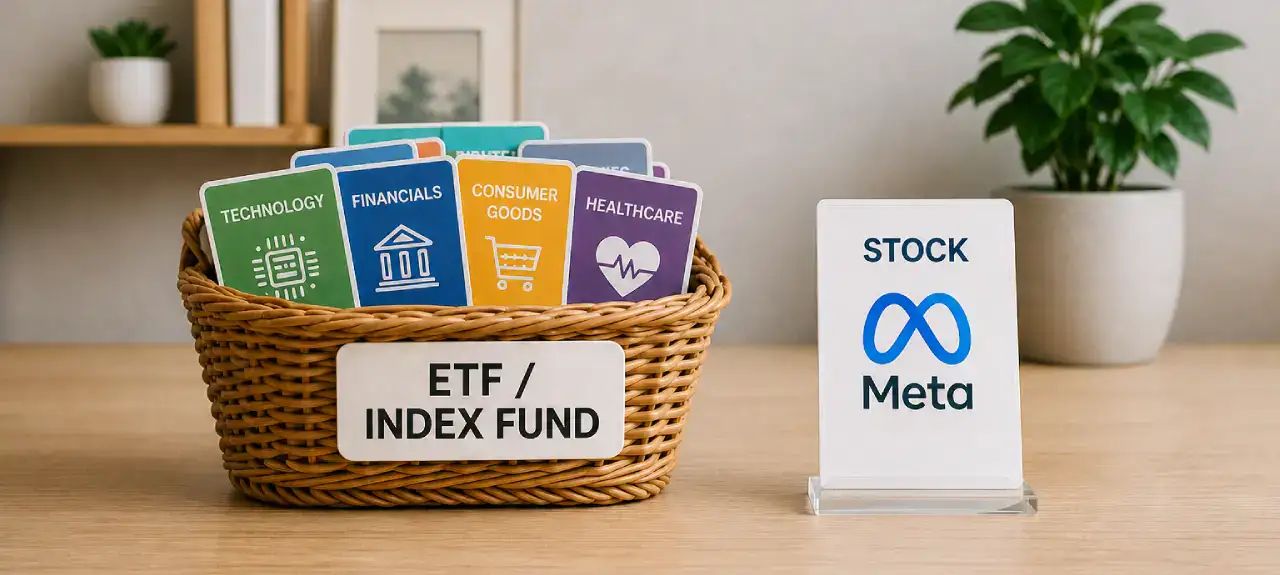
If you have read What Is an ETF? and Index Funds vs ETFs, you understand how to get into the stock market with one simple investment that instantly diversifies your money across companies and/or technologies.
The next question almost every new investor asks is this:
Should I stick with ETFs and index funds, or should I start picking individual stocks?
The honest answer is — it depends on where you are on your investing journey.
This post will walk you through both paths so you can figure out which one fits you right now.
A Quick Refresher
ETFs and index funds let you buy a small piece of many companies at the same time. One purchase, instant diversification. Bad news for one particular company does not dramatically impact the performance of the entire ETF or index fund.
On the other hand, individual stock investing is different.
Because when you buy an individual stock, you are buying shares of one specific company that you have researched and chosen yourself. Instead of buying the market, you are buying that one business. With this comes a lot of responsibility because you need to monitor news and performance for the individual company. You cannot take your eyes off the company, or you may miss that they missed earnings or lost a big contract or were named in a big lawsuit.
For example, let’s look at a simple example from recent times. On April 29, 2026, META (Facebook, Instagram) released earnings. The market did not take it well and META declined 8.6% in one day. META is a company included in the QQQ ETF we have discussed in other posts. On April 29, 2026, the QQQ increased in value almost 1%. In this example, owning the ETF led to a gain and owning the individual stock led to a decline. Please know there are plenty of examples the other direction — large individual stock gain with a modest ETF gain.
Both approaches can build wealth. They just require different things from you.
The Case for ETFs and Index Funds
For many people, ETFs and index funds are the right answer.
Here is why:
- Instant diversification. One company struggling will not sink your investment.
- Low fees and very little work. You do not need to research companies, read earnings reports, or follow the market every day.
- They quietly outperform most professionals. The reality is that most professional money managers fail to beat the S&P 500 over the long term. By owning an ETF that tracks the S&P 500, you are already doing what most experts cannot.
- Less stress. You are not watching one company every day, hoping it does not have a bad earnings report.
- Perfect for anyone who is busy, new, or simply does not want investing to be a hobby.
For many people, this is the right approach forever. There is nothing wrong with that. ETFs and index funds will build serious wealth over time if you start, stay consistent, and let time do its thing.
The Case for Individual Stocks
Once you have done the work to learn, individual stocks open up new possibilities.
- Higher potential returns. When you understand the businesses you own, you can hold a more concentrated portfolio of strong companies.
- You invest in what you believe in. You are no longer buying every company in the index — you can choose the ones you have studied and have conviction in.
- Dividend income. Many established companies pay dividends, which can become a meaningful source of income over time. See What are Dividend Stocks?
- Tax advantages. With individual stocks, you have more flexibility around when to take a gain or harvest a loss.
- A deeper financial education. Once you start picking stocks, you start understanding earnings, valuations, and how businesses actually work. That knowledge stays with you for life.
I personally try to hold around 20 stocks so my portfolio is diversified, and I also keep some money in ETFs. There is no rule that says you have to pick one or the other.
Where You Are on Your Journey Matters
This is the part most articles get wrong. The right answer is not the same for everyone — and it is not even the same for you forever. It changes as you grow as an investor.
Just Getting Started
If you are new to investing, start with ETFs and index funds while you build a knowledge base.
You do not yet know what you do not know. ETFs protect you from the mistakes every new investor makes — chasing the hot stock, buying high, panic selling low.
Build the habit first. Get comfortable watching your money grow. Learn what it feels like to leave money invested through ups and downs without touching it.
All the while, you can build a mock portfolio and start tracking stocks you like and your performance without risking real money. Start reading and watching CNBC when you have time, watch Jim Cramer’s Mad Money which was built for the average investor trying to learn. Lastly, start doing your homework. Jim Cramer says that once you start owning stocks, you should spend an hour per week understanding the stocks you own. You will always hear the term Buy and Hold but Mr. Cramer says Buy and Homework.
Building Your Knowledge
Over time, as you start to read, learn, and follow companies, you can begin putting a small portion of your money into individual stocks while keeping the core of your portfolio in ETFs and index funds.
This is not abandoning the safe path. You are adding to it.
This is also where the learning really accelerates. Once you own a piece of a real company, you start paying attention to it differently.
Experienced and Engaged
Someone who has spent years studying the market can run a more concentrated portfolio of individual stocks with confidence.
Even then, most experienced investors keep some money in ETFs. The two approaches work well together.
The Honest Truth About Picking Stocks
Most people who try to beat the market do not. The data is clear on this.
Stock picking takes real work. It means reading earnings reports, understanding valuation, and having the discipline to hold a stock when it drops 20% on a bad week.
If you are not willing to put in that work — and most people are not — that is completely fine.
ETFs and index funds will build real wealth over time. There is no shame in staying with them forever. Many millionaires were built on nothing more than consistent investing in broad market funds.
A Practical Approach
So how do you actually put this together?
Think of it this way:
- Keep the majority of your investments in ETFs and index funds. This is your foundation.
- As you learn, add individual stocks in a smaller portion of your portfolio.
- The percentage you put in individual stocks should match your knowledge level, not your enthusiasm.
A brand new investor might be 100% in ETFs.
Someone who has been studying for a few years might be 80% ETFs and 20% individual stocks.
Someone deeply engaged with the market might flip that ratio.
Let it evolve as you do.
Common Mistakes When Picking Stocks
If you do start buying individual stocks, here are the mistakes that trip people up the most:
- Buying based on a tip from a friend or a headline
- Chasing a stock that just had a huge run
- Falling in love with a story instead of a business
- Putting too much money into any one company. I have been doing this a while but the money I have invested in individual stocks is also very diversified. I personally try to not let one stock represent more than 5% of my overall portfolio.
- Panic selling the first time a stock drops. You might check out Trying to Time the Market? Here’s Why That’s a Costly Mistake
Avoid these and you are already ahead of most new investors.
Conclusion
ETFs and index funds are not a beginner’s tool you graduate from. They are a foundation that stays useful at every stage of your investing life.
Individual stocks are not for everyone. There is no rule that says you ever have to buy one.
In the end what matters, as always, is this:
Start investing. Stay consistent. Give your money time to grow.
What Comes Next
Now that you understand the difference between investing in ETFs/index funds and individual stocks, the next question is:
If you do decide to invest in individual stocks, how do you actually pick them?
That is what we will cover next.
Cheers!
Christopher



Weekly Notes — October 10, 2026