
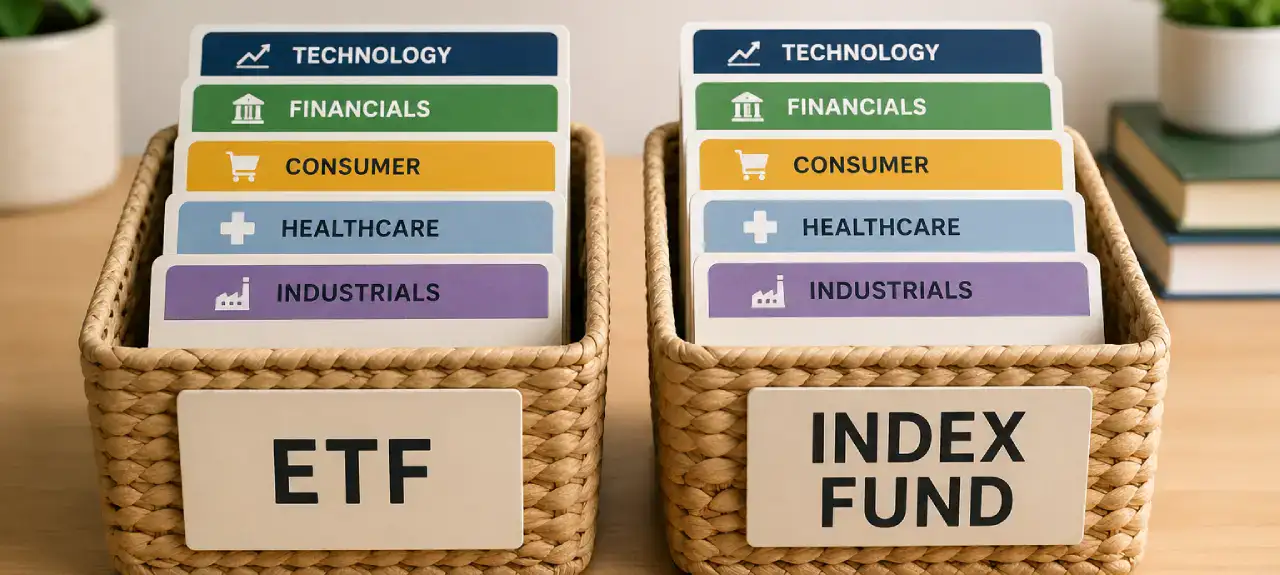
If you have learned what an ETF is, you have probably come across the term: index funds. In What Is an ETF?, we discussed the confusion of where to put your money once you have started saving it. Stocks, bonds, mutual funds, ETFs and, you guessed it, index funds.
At first glance, when you compare index funds vs ETFs, they can sound like two completely different things.
They are not. They are very similar.
In fact, this is one of the most common points of confusion for new investors.
So let’s simplify it.
What is an Index Fund?
An index fund allows you to invest and diversify across a group of companies and sectors.
As an example: an index fund might track the S&P 500 or the Nasdaq 100. Instead of trying to pick individual winning stocks when you are brand new to investing, an index fund will allow you to spread your one investment across many companies and technologies.
As with any investment, if the value of the index goes up over time, your investment and net worth increase accordingly.
Wait — Isn’t That What An ETF Does?
That is exactly what I said.
And this is what creates confusion. Many ETFs actually are index funds.
Both track a group of companies and/or technologies, provide diversification and are built for a long-term investment strategy.
So, if they are so similar, what is the difference?
The Real Difference Between Index Funds and ETFs
The main difference between these investment vehicles is how you buy them.
ETFs
- Trade like stocks. I gave examples of SPY and QQQ. You can buy 5 shares of SPY just like if you bought 5 shares of AMZN (Amazon).
- Because they trade like stocks, you can buy them throughout the day as the market is open
- The price will fluctuate during the day based on market conditions and specific news related to companies/industries.
Index Funds
- These do not trade like stocks
- Bought at the end of the day.
- Price is set once per day
Does This Difference Really Matter
For most people, the difference honestly doesn’t matter. Personally, I prefer ETFs because I can buy them like a stock and have an order executed immediately.
Both, however, allow you to diversify your investment, remove the need to pick individual stocks, and are excellent for long-term investing.
The biggest mistake people can make is thinking they need to pick the perfect ETF or the perfect Index Fund.
They don’t.
What Actually Matters
Whether you pick an Index Fund or an ETF does not matter. It really doesn’t.
What does matter, and you will get tired of me saying this — is starting to invest, staying consistent with your saving habits and giving your money time to grow.
What About the Fees
I want to be brief here or we will quickly get into more complicated topics.
At first glance, you might think an ETF has no fees because it trades like a stock and most platforms no longer charge you a fee to buy and sell stocks.
But both ETFs and Index funds have small built in fees called expense ratios.
There may also be a small trading cost for an ETF tied to the bid/ask spread which an Index Fund will not have.
In reality, both of these are very low cost and the minor differences should not impact your decision.
Which One Should You Choose
If you have access to a trading account, you have access to ETFs — they are simple and flexible.
If your 401(k) offers index funds, those are equally as effective. Many employer offered retirement accounts utilize index funds. Mine as an example has index funds specifically focused on the year someone plans to retire.
What is inside each of these investment options is very similar.
Conclusion
An ETF and an Index Fund have more similarities than differences.
Both are simple, offer diversification and are built for long-term investing.
Don’t spend a lot of time choosing which is right.
The key is, as you guessed:
Start Investing. Stay Consistent.
Now that you understand the difference between an ETF and an Index Fund, the next question is this:
Should you invest in one of these vehicles or individual stocks?
This is where differences really start to matter and what we will cover next.
Cheers!
Christopher



Weekly Notes — October 10, 2026